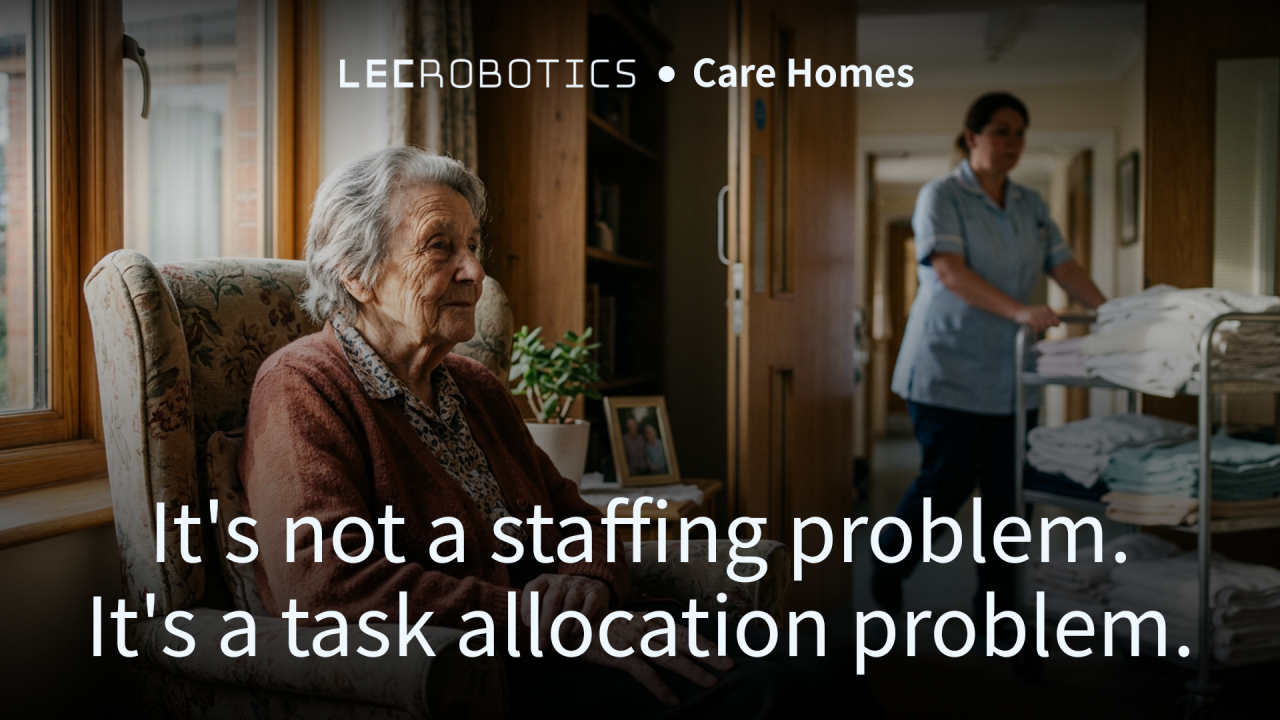
Care homes don't have a staffing problem. They have a task allocation problem.

Introduction
Here's the uncomfortable thing about care home rotas: most of them aren't short on people. They're short on people doing the work that actually needs a carer. The fix is mostly upstream of recruitment.
It's a Tuesday at 8.15am. The deputy manager is on her third call to the agency before breakfast is finished. One carer has called in. Two more are running late. The upstairs corridor was already light on the rota, and now it's lighter still. By 10am she's covered. By 2pm she's spent her morning chasing cover instead of doing handover, signing off care plans, or sitting with the family in room 12 who came in to talk about end-of-life decisions.
Not because there aren't enough carers in the building. Not because the home is mismanaged. But because too many of the people on shift will spend half their day pushing trolleys, walking laundry up two floors, and fetching the things residents need but nobody planned to bring.
The received wisdom blames the labour market. Operators talk about retention, agency costs, the impossibility of finding carers, the post-Brexit visa rules. All of it real. None of it the whole story. In almost every home we've walked through this year, a meaningful slice of the rota was being burned on tasks that didn't need a carer; they just needed someone with legs and a uniform. Three patterns show up over and over.
The amenity run that eats the morning
A resident on the second floor needs fresh towels. The carer on the first floor walks up, then back down. Twice. By the time she's done, that's twenty minutes she could have spent doing meds round, or the personal care that's actually in her job description. Multiply that across a 40-bed home, three corridors, and a Tuesday-morning shift, and you've burned an hour of senior carer time before tea break. None of that hour was care.
The kitchen relay
Lunch service is the giveaway. The kitchen plates up. Someone needs to push the trolley to each dining room or to each room for room service. That someone is, almost without exception, a carer who had to step away from the resident she was helping into a chair, because the kitchen called and there's nobody else. The home isn't short-staffed at lunch. It's short on people who can be in two places at once.
The "can someone just grab" problem
This is the variance task. A pharmacy delivery arrives. A relative drops off a parcel. A maintenance issue means a corridor light needs replacing. Each individual ask is small. None of them are anyone's job. They land on whichever carer is closest. Across a week, the closest carer ends up running thirty of them. That's a shift of unaccounted-for tasks, on top of the actual rota.
Here's the pattern in every home that got this right
The homes that solved this didn't hire their way out. They didn't restructure the rota. They didn't add a coordinator. They looked at the day honestly and asked which tasks needed a carer's hands and which just needed something to move from A to B. Then they took the second category off the rota. Some of it went to a different role. Some of it went to a delivery robot. Either way, the carers stopped being the default mover for everything in the building.
On the homes we've worked with this year, operators typically recover 10–15 hours of carer time per week, per home. That's the difference between needing an agency call on Wednesday and not making one. It's also the difference between a good carer staying through the year and leaving in month four because the work they trained for kept getting interrupted by trolleys. On the sites we've seen, that retention difference is itself worth roughly £4,000–£6,000 per avoided hire, and that's before you count the residents whose afternoons stopped feeling rushed. Residents don't resent the robot. They resent rushed care.
The implication is straightforward. Your home isn't short on staff. The work isn't impossible. What matters is being honest about which fifteen minutes of which carer's day is going to a task that doesn't need a carer, and protecting that time. That's the prep that turns a chaotic Tuesday into a calmer one, not a bigger rota.
If you're running a care home and want to look at which of those tasks could come off the rota next quarter, our assessment partner Pritpal walks operators through it in 30 minutes. No slides, just your rota and a conversation. Book a slot here.

Related posts
Explore more articles like this to deepen your understanding and discover new insights on similar topics.


The Missing Layer in AI
Blog Description Sed ut perspiciatis unde omnis iste natus error sit.
The Missing Layer in AI
Blog Description Sed ut perspiciatis unde omnis iste natus error sit.
The Missing Layer in AI
Blog Description Sed ut perspiciatis unde omnis iste natus error sit.